Call for Proposals
The American Journal of Orthopsychiatry (AJO) invites submissions for a special issue entitled, “Bending Towards Justice: Organizational Case Studies of Courage and Hope.” The aim of this special issue is to amplify community voices and illuminate who they are, what they do, and how they are navigating current challenges to promote social justice. We are looking for proposals from organizations that provide services and advocacy in the United States and U.S. territories. We hope that this special edition, which is a collection of works authored by community-led organizations, epitomizes examples of social change agents and advances narratives of community ownership and empowerment. We welcome submissions from people working in various community sectors (e.g., nonprofit, foundations) seeking, in line with the journal’s mission, to promote mental health and well-being through social justice and systemic change.
For this special issue, we encourage submissions from non-academic organizations. We also welcome submissions from community organizations that work with academic partners as long as the organization’s narrative is the focus of the submission. We encourage contributors to be authentic in telling their stories and journeys.
Contributions to this special issue will be structured differently from typical academic journal articles (see Sections I & II below). For example, organizations are not required to include traditional citations or supplemental materials such as tables or graphs to describe their work. We anticipate that typical submissions will be approximately 8-10 double-spaced pages in Times New Roman 12-pt. Font (approximately 2,000 to 2,500 words). The editorial team can help you access or locate sources and references needed for full submissions. A publishing team will be available to assist with manuscript editing services (e.g., formatting, style/tone, proofreading).
Key terms:
Proposal: A brief summary (no more than 350 words) about your organization.
Submissions: A full-length article that you submit for review. ‘Proposals’ that are selected for inclusion in the special issue will be invited to submit a full-length article that provides more detailed information about their organization in more detail (see Sections I & II). The full-length article will undergo ‘peer review.’
Peer-Review: The process in which subject/content matter experts are invited by this special issue’s editorial team to read your submission and provide you with constructive feedback.
Contributor: You and/or your team of authors.
Contributions: The full-length article that is finalized, approved, and accepted for inclusion in the special issue.
For Proposals (no more than 350 words), please briefly describe:
Section I: Required information to be included in each proposal and submissions:
1) Details about the organization, including mission statement, individuals served, services provided, U.S. service location(s), and the societal injustice(s) the organization has historically/currently addressed.
2) Impact of the current sociopolitical climate on your mission and day-to-day work (e.g., changes or adaptations to language, programming, structure, funding strategies, or partnerships).
3) Strategies or initiatives that highlight the organization’s capacity to carry out its mission despite obstacles.
4) Lessons learned that might inspire others doing justice work in difficult environments.
5) Sources of hope at this moment.
For Invited Submissions (approximately 2,000 to 2,500 words), please expand on the information above and consider including additional information. For example, you may wish to include one or more of the following (select no more than three):
1) The way specific policies or cultural shifts have posed challenges or barriers to your efforts.
2) The way your team, volunteers, and/or community remained resilient and continued to engage in advocacy/positive change for those you serve.
3) Partnerships or coalitions that have been most crucial in navigating tough sociopolitical times.
4) Strategies employed to ensure marginalized voices are centered in decision-making during crisis moments.
5) Guiding principles that help the organization discern when to speak out publicly or take action.
6) How do you envision the organization advancing social justice in the future?
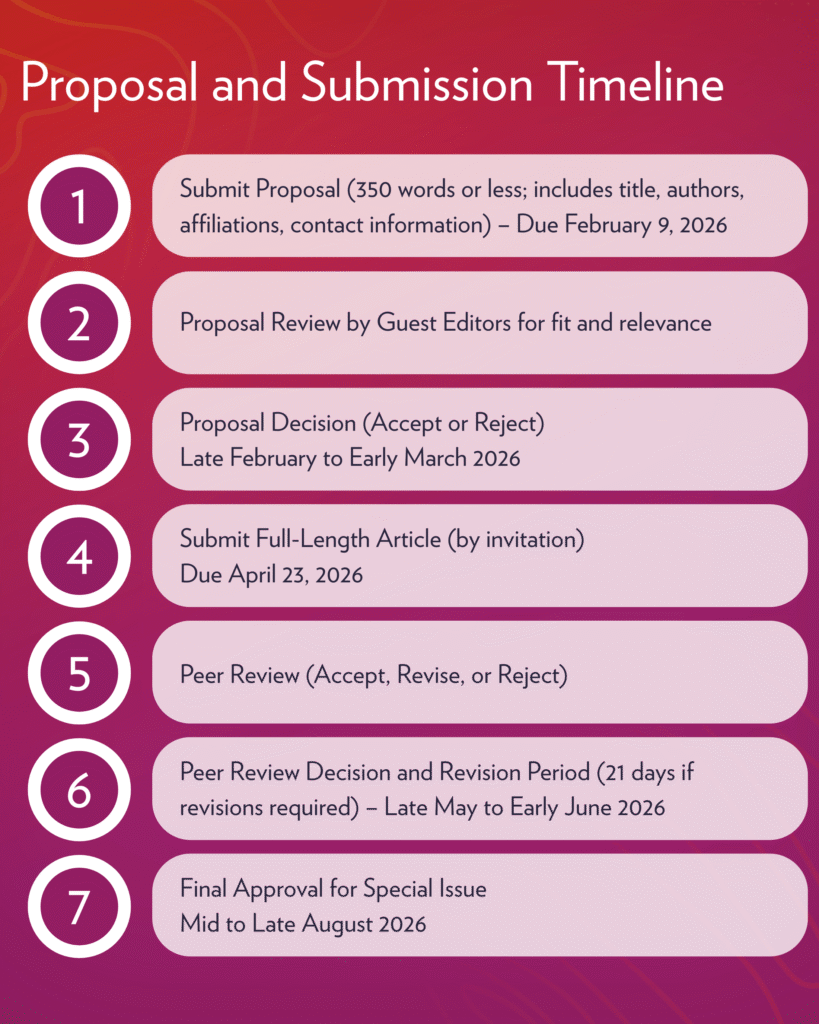
PROPOSAL AND SUBMISSION PROCESS AND TIMELINE
Step 1: Submitting a proposal is the first step in the process. The team of guest editors will review all proposals and select those that best match the theme and goals of the special issue. If your proposal is accepted, you will be invited to submit a full-length article.
- Proposals should include a working title, author(s) name(s), organization name(s), and contact information.
- Proposals should be no more than 350 words and provide summarized responses to the 5 items listed in Section I. Proposals are intended to give the editorial team a brief, yet insightful, glimpse into what your full-length article, if accepted, would contribute to this special issue.
- Proposal Length: No more than 350 words. (Title, name(s) and contact information is not included in the word count.)
Deadline for Proposals: February 9, 2026 (Please email proposals to gro.e1775072150citsu1775072150jhb@O1775072150JA1775072150 using the Subject line: Special Issue Proposal)
Step 2: Proposal review process. Proposals will be reviewed by the special issue’s team of guest editors for content, relevance, and contribution to the theme.
Step 3: Notification of Proposal Decision (Accept/Reject): The anticipated date of notification of whether your proposal was accepted or rejected is late February/early March 2026. Accepted proposals will be invited to submit a full-length article for peer review.
Step 4: Deadline to Submit Full-length Articles (Submissions Due): April 23, 2026
Step 5: Peer review process: Submissions will be reviewed by the guest editorial team and invited subject/content matter experts. Based on the feedback from the peer review process, your manuscript will be returned to you along with one of the following editorial decisions with a rationale and substantive, constructive feedback:
a) Accept with no revisions (rare initial decision – even the best papers generally have some room for improvement)
b) Major or minor revisions (generally most common decision for invited submissions; submissions may require more than one round of revisions)
c) Reject (submission was not accepted for inclusion in the special issue)
Step 6: Notification of peer-review process editorial decision (Accept/Revise/Reject): The anticipated date of notification of whether your submission was accepted, requires revisions, or was rejected is late May/early June 2026. Upon notification of the peer-review process editorial decision, manuscripts that require revisions will have a 21-day deadline to resubmit the manuscript with the edits in tracked changes.
Step 7: Finalized contributions turned in for special issue collection: We anticipate that all submissions will be finalized and approved by the editorial team in mid-late August 2026.